


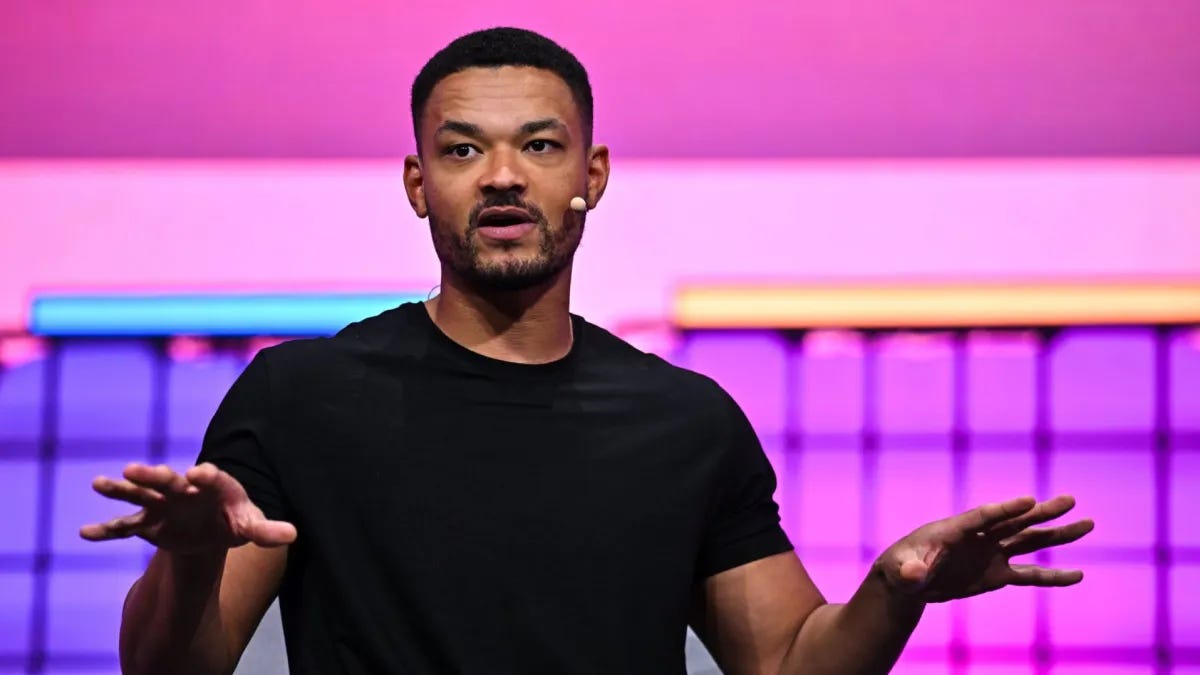
Steven Bartlett posted something this week that broke the internet’s brain. Two glasses of wine, he said, derailed three days of his life. Sleep destroyed. Workouts wrecked. Recovery score tanked. All of it tracked, quantified, graphed, and served back to him on a little screen strapped to his wrist.
The internet dunked, hard I dunked too, if only in my head, somewhere between my second glass of Gamay and the third person who sent me the clip.
But here’s the thing I keep coming back to: Steven Bartlett might not be wrong that wine affected his sleep. He’s wrong about what that means for the rest of the world of non-optimisers.
The device is the problem
Whoop is a great product for athletes in training cycles. It is a terrible product for humans trying to live.
When you strap a biometric tracker to your wrist and give it permission to narrate your biology, you are outsourcing your self-knowledge to an algorithm. You wake up after a dinner that felt good - friends, laughter, a bottle of something awesome and fucking delicious - and instead of trusting how you feel, you check your recovery score. It says 34%. Suddenly your world falls apart.
This is not wellness - this is anxiety with a subscription fee.
Of course wine affects sleep architecture. And yes, alcohol suppresses REM sleep. This is real, documented physiology. But so does a bad day at work. So does eating 2 Snicker bars too late. So does the three cortisol spikes you got from doomscrolling Tiktok between sets at the gym. None of those get the same TED-talk energy.
We are pathologising pleasure in real time and calling it optimisation.
I grew up in Bosnia where we didn’t have this problem
My grandad didn’t track his HRV. He drank šljivovica at 11 am every day watching my grandma smoke cigarettes with her coffee on the porch, and they both lived into their eighties. This is not a health argument - I am not suggesting you pick up a pack of Marlboros for longevity. In Bosnia, wine and rakija and strong coffee and late dinners weren’t vices to be managed. They were the fabric of life. They were how you sat with your father after a hard week. How you celebrated a baptism or mourned a funeral. How you argued about football until 2am and still showed up to work the next morning without telling anyone your recovery score.
Growing up in that culture gave me something I now consider one of my more useful inheritances: a baseline immunity to softness around pleasure.
I don’t mean toughness in the macho sense. I mean the capacity to enjoy something fully without immediately auditing it. To have a glass - or three - of something beautiful without the hangover being self-inflicted before the alcohol even metabolises.
The biohacker’s relationship with wine is fundamentally anxious. Mine, shaped by the Balkans and sharpened by over a decade in wine, is fundamentally grateful.
A note on what wine actually is
I’ve been in wine professionally for 16 years. I’ve poured wine for pairings on a Michelin-starred restaurant floor, sourced bottles from mountain producers in Yunnan, and stood in cellars across Bosnia talking to winemakers whose families survived things that make a bad Whoop score look like a rounding error.
Wine is not a health food. It’s also not a poison. It’s a fermented agricultural product made by human hands from a piece of land, and when it’s good - when it’s really good - it is one of the most concentrated expressions of place and craft that exists on earth.
Two glasses of a well-made wine, enjoyed slowly, with food, with people you like, in a room that doesn’t have a television on - that is not a biohack. That is the core of civilisation.
The idea that it should cost you nothing physiologically to participate in civilisation is the kind of thinking that turns reasonable people into supplements-only, 9pm-bedtime, macro-tracking androids who have technically optimised their body and completely lost their life.
The real ruined days
Here’s what I think actually happened to Steven Bartlett.
He drank two glasses of wine. He checked his Whoop. His Whoop told him he was compromised. He spent three days performing the identity of someone who had been compromised. The device gave him permission to feel bad, and he took it.
That’s not the wine’s fault - it’s a crisis of self-trust.
And I say this without malice - Bartlett is smart, and I understand the appeal of the quantified self for high-performers trying to squeeze margin out of every day. But there is a cost to that approach that doesn’t show up on any dashboard: you stop being able to feel your own life without an intermediary.
What I’d tell anyone who sent me that clip
Drink the wine. Choose something worth drinking. Eat with it. Don’t drink it at midnight before a 6am flight. Don’t chase it with six more at a rooftop bar. Don’t make it a habit that’s actually about numbing something you haven’t looked at yet.
But also: stop auditing your pleasure before you’ve even finished having it.
Two glasses of a good bottle with people you love is not a performance problem. It is the performance.
As always, thanks for reading - stay thirsty, stay curious. If you would like to further support me, you can follow me on Instagram or LinkedIN or tell your friends about this newsletter.
Aleksandar
I’ve been ruminating on what Steven Bartlett said for three days.
He ruined three days of my life!!!
Safe to conclude that I will do everything in my power to never watch a single minute of his misleading, shitty show again. If I had a Whoop, it would tell me I need to stop watching uninformed crap made by stupid people who are perfectly fine spreading misinformation for financial gain.
But I don’t have a Whoop.
I have a life instead.
Really enjoyed this piece.
I'm from Patagonia, Argentina, and while the Balkans and South America are obviously very different places, I couldn't help feeling there is something familiar in the way you describe wine, food, family and pleasure. Not as products to optimize around, but as part of life itself.
The line about not immediately auditing pleasure resonated with me a lot. Lately I've been writing about wine myself, and one of the ideas I keep coming back to is that wine is often at its best when it's not the main character. It's a reason to sit down, stay longer, listen to people, argue, celebrate, remember, or simply be present.
I'm still relatively new to the wine world and currently studying to become a sommelier, so it's encouraging to find people writing about wine from this perspective. There's plenty of technical content out there, but much less about hospitality, community, and the human side of why wine matters in the first place.
Thanks for writing it.